Extraordinary Environment and Planning Committee
10 June 2025
 |
Extraordinary Environment and Planning Committee
10 June 2025
|
Meeting Notice
The Extraordinary Environment and Planning Committee
of Central Coast Council
will be held in the Function Room 2,
2 Hely Street,
Wyong,
on Tuesday 10 June 2025 at 7:00pm,
for the transaction of the business listed below:
1 Reports
1.1 Introduction: Welcome, Acknowledgement of Country, and Apologies............................................................................................................ 5
1.2 Disclosures of Interest.................................................................................... 6
1.3 MacMasters Beach Temporary Coastal Protection Works............... 8
1.4 FOGO (Food Organics Garden Organics) Facility Business Case Report - referral to Council to seek Expression of Interest.............. 9
1.5 Draft Flood Risk Management Policy - for Public Exhibition........ 21
1.6 Planning Proposal Statistics...................................................................... 25
Membership
|
Deputy Mayor Doug Eaton OAM |
Chairperson |
|
Cr Sharon Walsh |
Deputy Chairperson |
|
Cr Margot Castles |
Member |
|
Cr John Mouland |
Member |
|
Cr Jane Smith |
Member |
|
Cr Rachel Stanton |
Member |
|
Cr Kyle MacGregor |
Alternate 1 |
|
Cr John McNamara |
Alternate 2 |
Deputy Mayor Doug Eaton OAM
Chairperson
WELCOME
ACKNOWLEDGEMENT OF COUNTRY
We acknowledge the Traditional Custodians of the land on which we live, work and play.
We pay our respects to Darkinjung Country, and Elders past and present.
We recognise the continued connection to these lands and waterways and extend this acknowledgement to the homelands and stories of those who also call this place home.
We recognise our future leaders and the shared responsibility to care for and protect our place and people.
APOLOGIES
DISCLOSURES OF INTEREST
|
Chapter 14 of the Local Government Act 1993 (“LG Act”) regulates the way in which the councillors and relevant staff of Council conduct themselves to ensure that there is no conflict between their private interests and their public functions.
Section 451 of the LG Act states:
“(1) A councillor or a member of a council committee who has a pecuniary interest in any matter with which the council is concerned and who is present at a meeting of the council or committee at which the matter is being considered must disclose the nature of the interest to the meeting as soon as practicable.
(2) The councillor or member must not be present at, or in sight of, the meeting of the council or committee:
(a) at any time during which the matter is being considered or discussed by the council or committee, or (b) at any time during which the council or committee is voting on any question in relation to the matter.
(3) For the removal of doubt, a councillor or a member of a council committee is not prevented by this section from being present at and taking part in a meeting at which a matter is being considered, or from voting on the matter, merely because the councillor or member has an interest in the matter of a kind referred to in section 448.
(4) Subsections (1) and (2) do not apply to a councillor who has a pecuniary interest in a matter that is being considered at a meeting, if:
(a) the matter is a proposal relating to:
(i) the making of a principal environmental planning instrument applying to the whole or a significant part of the council’s area, or
(ii) the amendment, alteration or repeal of an environmental planning instrument where the amendment, alteration or repeal applies to the whole or a significant part of the council’s area, and
(a1) the pecuniary interest arises only because of an interest of the councillor in the councillor’s principal place of residence or an interest of another person (whose interests are relevant under section 443) in that person’s principal place of residence, and
(b) the councillor made a special disclosure under this section in relation to the interest before the commencement of the meeting.
(5) The special disclosure of the pecuniary interest must, as soon as practicable after the disclosure is made, be laid on the table at a meeting of the council and must:
(a) be in the form prescribed by the regulations, and (b) contain the information required by the regulations.”
Further, the Code of Conduct adopted by Council applies to all councillors and staff. The Code relevantly provides that if a councillor or staff have a non-pecuniary conflict of interest, the nature of the conflict must be disclosed as well as providing for a number of ways in which a non-pecuniary conflicts of interests might be managed.
|
That Committee members and staff now disclose any conflicts of interest in matters under consideration at this meeting.
MacMasters Beach Temporary Coastal Protection Works
Verbal Update
|
Item No: 1.4 |
|
|
Title: FOGO (Food Organics Garden Organics) Facility Business Case Report - referral to Council to seek Expression of Interest |
|
|
Department: Infrastructure Services |
|
|
10 June 2025 Extraordinary Environment and Planning Committee |
|
Reference: F2020/00328 - D16755679
Author: Darren North, Section Manager Waste Services
Andrew Pearce, Unit Manager Waste and Resource Recovery
Executive: Boris Bolgoff, Director Infrastructure Services
That the Committee:
1 Accepts the attached Business Case remain confidential as the Business case contains:
a. information that would, if disclosed, confer a commercial advantage on a person with whom the council is conducting (or proposes to conduct) business.
b. commercial information of a confidential nature that would, if disclosed-
i. prejudice the commercial position of the person who supplied it, or
ii. confer a commercial advantage on a competitor of the council, or
iii. reveal a trade secret.
2 Receive and note the Confidential ‘FOGO Facility Business Case (Final Draft)’ and redacted versions of the attachments.
3 Accepts the findings within the Business case and recommends,
i) progression to the Expression of Interest (EOI) stage for the FOGO Facility,
ii) advising the Office of Local Government (OLG) of Councils intention to proceed with the Public Private Partnership (PPP) model.
4 Notes that a report be provided to the Environment and Planning Committee that summarises all (EOI) submissions and provides a recommendation on next steps.
5 Recommends to Council that Council adopts the following:
i. receives and notes the recommendations and confidential Business Case and attachments from the Environment and Planning Committee.
ii. agrees with the Business Case recommendations and findings and accepts the draft FOGO Facility Business Case as being the Final FOGO Facility Business Case.
iii. agrees that the development of at least 100,000 tonne p/a In Vessel Composting FOGO Facility constructed at Councils Buttonderry Waste Management Facility remains a viable project and will facilitate Council's compliance with upcoming regulatory change, and that this proceeds to an Expression of Interest (EOI).
iv. agrees to proceed to an EOI with the FOGO Facility project, as ascertained within the FOGO Facility Business Case, as a Build Own Operate and Transfer (BOOT) contract delivered via a Public Private Partnership (PPP) which requires assessment by Office of Local Government (OLG) prior to proceeding.
v. authorises the CEO to certify that all documents put forward to the OLG from Council are prepared in accordance with The Public Private Partnership (PPP) Guidelines and lodge the authorised documents and FOGO Facility Business Case PPP proposal with OLG for assessment.
vi. endorses the FOGO Procurement Plan as identified in Attachment F of the FOGO Facility Business Case and subject to OLG agreement, authorises the release of an Expression of Interest for the development of a FOGO Facility under a BOOT and PPP contract.
vii. that a further report be provided to the Infrastructure and Assets Committee on the outcome of the EOI process, with recommendation(s) on subsequent actions, and that any Infrastructure and Assets Committee recommendations be included in a subsequent report to Council.
|
This Report and Recommendations are required to allow the progression of the draft FOGO Facility Business Case to be accepted as a Final FOGO Facility Business Case and to enable Council to submit an application to the Office of Local Government (OLG) seeking approval to progress the development of a FOGO processing Facility at Councils Buttonderry Waste Management Facility via a Public Private Partnership delivery model, and subsequently release an Expression of Interest to the market inviting suitable contractors to engage in a Build Own Operate and Transfer procurement process.
Executive Summary
Central Coast Council (CCC or Council) is planning to develop and deliver a FOGO facility aimed at enabling the implementation of a FOGO collection Service for the Community that complies with the NSW FOGO Mandate. The facility is required to manage and process food and garden organic materials both collected and delivered from households and businesses within the Local Government Area (LGA). Increasing the region’s processing capacity for organics and the availability of a FOGO service to Central Coast residents and businesses represents a key initiative of the CCC Resource Management Strategy 2020-2030 and aligns with the Protection of the Environment Legislation Amendment (FOGO Recycling) Bill.
Council in May 2024 resolved the following:
That Council:
156/24 – Receives the attached Food Organics and Garden Organics (FOGO) Feasibilityreport findings and contents.
157/24 – Notes the actions listed at Table 7-2 in the FOGO Feasibility report be undertaken to inform the FOGO Business Case.
158/24 – Approve progression to Stage 3 - FOGO Business Case development, which is to be submitted to Council for consideration and approval prior to implementation of any FOGO Services or FOGO Tenders or FOGO Contract(s) commencing.
159/24 – Resolves, pursuant to section 11(3) of the Local Government Act 1993, that Attachment 2 remain confidential in accordance with section 10A(2)(c) and 10A(2)(d)(iii) of the Local Government Act as it contains commercial information of a confidential nature that would, if disclosed prejudice the commercial position of the person who supplied it and because consideration of the matter in open Council would on balance be contrary to the public interest as it would affect Council’s ability to obtain value for money services for the Central Coast community.
This Business Case is provided in response to the above resolution.
The proposed facility will be designed to process FOGO from Central Coast of approximately 100,000 tonnes annually. The proposed facility will divert a significant proportion of food and green waste generated in the CCC area, helping reduce methane generation and extending the current landfill lifespan. It will produce a compost product supporting circular economy objectives by recovering organics and using them beneficially to aid in soil health and plant growth. Regional economic benefits are expected from local employment opportunities arising during both construction and operations over a 20-year term.
The project is proposed to be delivered through a Public-Private Partnership (PPP) involving a Build Own Operate Transfer (BOOT). The FOGO Facility Business Case has been prepared to meet the requirements of a previous Council resolution and NSW OLG PPP requirements. The FOGO project is currently at a hold point pending Council decision to proceed to tendering stages. |
|
|
Background
The Executive Leadership Team (ELT) have received and reviewed the FOGO Facility Business Case on 25 March 2025 and supported that the Draft FOGO Facility Business Case be submitted Council seeking instruction to proceed to the procurement stages as outlined in the FOGO Facility Business Case.
The following Figure 1 indicates the FOGO ‘Journey’ to date and highlights where Council site along the approval’s pathway.
Figure 1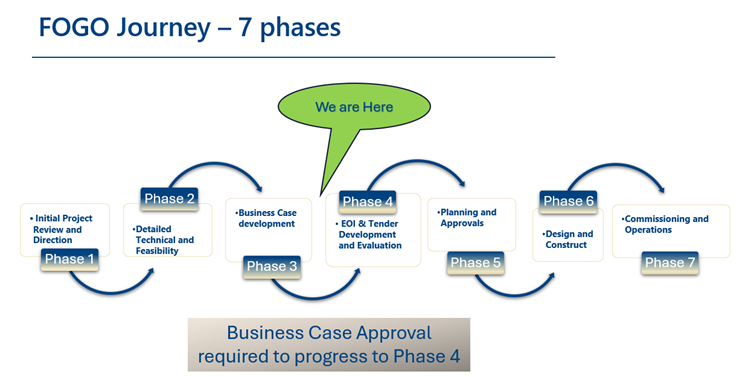
FOGO Facility Business Case Development
The FOGO Facility Business Case has been developed via a staged and iterative approach. Each stage has identified a broad range of aspects and issues, analysed, and assessed options, and selected best solutions to inform subsequent stages and direction.
The following key stages have previously been undertaken to inform and support the final approach and information within the Business Case.
Directions Paper – Noted and accepted by Council resolution February 2023
The Directions Paper reviewed and identified the following key aspects and recommended proceeding to the Feasibility Stage.
· Review of market capacity – current processing and facility availability
· Technology – review of available technologies and processing systems
· Delivery options – methodology for procurement of processing capacity
· Locations and availability – availability of existing or potential facilities or suitable development land
· Volumes and capacity estimates – estimated CCC FOGO generation tonnages
· High level cost estimates – estimation of potential cost scenarios
· Recommended to undertake Feasibility study to further refine assumptions.
Technical and Financial Feasibility Study – Received and accepted by Council resolution May 2024
The Feasibility Stage further explored the range of options within the directions paper and included the following actions and recommended that the project remained a viable solution and to proceed to Business Case.
· Narrow down the range of options available
· Refinement of location – site access, geotechnical assessment, constraints
· Refinement of feedstock – approximation of tonnages, facility sizing, growth
· High level financial modeling – funding sources, opportunities, delivery mechanisms
· Further analysis of delivery models – preliminary risk identification, delivery scope, procurement method.
· Identification of key detailed work to be undertaken – identified several key items requiring detailed assessment and decisions to inform the Business Case.
Central Coast Council faces growing regulatory and environmental pressures to improve resource recovery, with the Central Coast Resource Management Strategy 2020-2030, NSW Waste and Sustainable Materials Strategy 2041, and the FOGO Mandate requiring Councils to provide household FOGO collection services. Rising landfill levies, stricter Environment Protection Authority (EPA) waste regulations, and state-wide diversion targets necessitate scalable processing solutions to reduce costs and reliance on landfill.
At present, neither Council nor the private sector possess the necessary processing infrastructure within the broader region required to process FOGO materials derived from the Central Coast Local Government Area. The development of a large-scale FOGO processing facility represents a cost-effective and environmentally sustainable solution to improve landfill diversion, reduce greenhouse gas (GHG) emissions and promote circular economy outcomes.
Report
The Central Coast Council (CCC and Council), via a PPP process, is planning to develop and deliver a Food Organics and Garden Organics (FOGO) Facility (the Facility) aimed at managing and processing food and garden organic materials collected from households and businesses within its Local Government Area (LGA).
Increasing the region’s processing capacity for organics is a key initiative of the CCC Resource Management Strategy 2020-2030. It also aligns with the Protection of the Environment Legislation Amendment (FOGO Recycling), an Act which amends the Protection of the Environment Operations Act 1997 (the FOGO Mandate) to enable the source-separated collection of FOGO. The development of the proposed facility is also consistent with the aims of the NSW Waste and Sustainable Materials Strategy 2041 and the NSW Net Zero Plan3.
The Facility will be designed to process approximately 100,000 tonnes of FOGO waste annually, with a nameplate capacity of 123,600 tonnes per annum (tpa) to accommodate seasonal fluctuations throughout the year. Initially, organic material will be sourced exclusively from CCC. However, there remains scope to engage neighbouring Councils, commercial entities, or other regions as future supply partners. The Facility will employ In-Vessel Composting (IVC) technology, consistent with Council objectives and in response to market requirements.
It is expected that the proposed Facility will divert a proportion of food and green waste generated in the CCC area, helping reduce methane generation and extending the current landfill lifespan. It will produce a compost product supporting the LGA’s circular economy objectives by recovering waste organics and using them beneficially to support soil health and plant growth. Regional economic benefits are expected from local employment opportunities arising during both construction and operations over a 20-year term.
The project is proposed to be delivered through a Public-Private Partnership (PPP) involving a Build Own Operate Transfer (BOOT) contract, with capital expenditure financing from private sector investment, and with funding primarily from the payment of gate fees for the processing of FOGO material by Council. A Directions Paper and Feasibility Report have identified a suitable site at the Buttonderry Waste Management Facility (BWMF), located at 850 Hue Hue Road, Jilliby NSW 2259, based on factors including site access, proximity to the M1 motorway, land size and access to known easements.
This proposal represents a strategic investment in NSW’s sustainable waste management infrastructure, delivering long-term environmental, economic, and social benefits while supporting local, state, and federal government waste diversion objectives.
Public-private partnerships (PPP) are defined in s. 400B of the NSW Local Government Act. Generally, PPPs are arrangements whereby a council joins with a private person or entity to provide public infrastructure, a facility and/or a service where the council retains an interest, liability, or responsibility.
Section 400B
1. For the purposes of this Act, a public-private partnership means an arrangement:
a. between a council and a private person to provide public infrastructure or facilities (being infrastructure or facilities in respect of which the council has an interest, liability or responsibility under the arrangement), and
b. in which the public infrastructure or facilities are provided in part or in whole through private sector financing, ownership or control, but does not include any such arrangement if it is of a class that has been excluded from the operation of this Part by the regulations.
1A. For the purposes of subsection (1), the provision of public infrastructure or facilities includes the delivery of services during the carrying out of any project under the public-private partnership.
In general terms, a public-private partnership is an arrangement between a council and a private entity/person to provide public infrastructure or facilities that are provided in part or in whole through private sector financing, ownership, or control.
As this project will fall under the definition of a PPP, Council must not enter a PPP or carry out works under a PPP without notification that it has satisfied OLG / PRC that the project complies with the OLG PPP guidelines and Council must submit all PPP proposals to OLG for initial assessment before entering any arrangement (written or verbal) with a private party.
The OLG PPP Guidelines state as per Section:
11.2.2 Certification and Council Resolutions GM Certification
The General Manager(s) of the council(s) involved must certify that all documents put forward by Council are prepared in accordance with the Guidelines. This will need to be attached to each submission made to the OLG.
Council Resolution on outcomes and deliverables of the project
It is vital at this early stage that council determines what the project will deliver so that it can make a clear and unambiguous resolution to that effect. It is expected that at this step council will have before it the material it is intending to submit to OLG for assessment under these guidelines.
Council is to provide a copy of the minutes showing that council resolved to agree with the specific outcomes and deliverables for the project and a copy of the relevant council reports is required.
Council Resolution to proceed with the project as a PPP and submit to OLG for assessment.
A copy of the minutes showing that council resolved to proceed with the project as a PPP and authorising the GM to submit the proposal to OLG for assessment is required.
The subject report, the FOGO Facility Business Case, and the listed recommendations are intended to fulfil the OLG PPP requirements.
FOGO Facility Business Case
The FOGO Facility Business Case is attached (Attachment 1). All information and recommended pathways within the Business Case are supported by extensive background research, documentation, and evidence.
To inform the Business Case, and evidence the underlying information and drivers, the following summarises the key investigations and comprehensive reports that were completed as part of the Business Case Development. This detail can be referenced if a particular item within the Business Case needs further understanding.
· Market Sounding Insights Report: A summary of the key themes and discussion points relevant to assessing the interest, capacity, and capability of market participants in procuring a FOGO facility.
· Procurement workshop analysis: Comparative and Multi Criteria Assessment (MCA) of key procurement methods utilising industry feedback and risk impacts.
· FOGO Delivery Options MCA: An MCA was undertaken to determine the optimal contractual arrangement for the facility, collection and education activities to best align with Council’s various requirements and objectives.
· FOGO Facility CAPEX and OPEX Estimates: Independent assessment by Quantity Surveyors on total CAPEX cost of project, and OPEX costs based on known operating projects and current market status.
· Financial Analysis Report: Analysis to quantify the anticipated Whole-of-Council cost impact of the overall FOGO project, including impacts of related activity, such as costs for new bins, caddies, education, and other associated expenses, as well as changes in waste collection and disposal approaches Directions Paper.
· FOGO Procurement Strategy: Detailed strategy integrating previous work and aligns with the NSW Office of Local Government (OLG) Public-Private Partnership (PPP) Guidelines, to provide a framework for the procurement of a Build Operate Own Transfer contract with emphasises on compliance, transparent and competitive processes, and to achieve Value for Money outcomes.
Delivery of the FOGO facility is expected to achieve the following outcomes:
· Regulatory compliance – Ensure Council and businesses within the LGA can meet NSW waste regulations and the FOGO mandate.
· Landfill diversion – Reduce organic waste currently being landfilled as approximately 40% of the Red Bin content is Organic material.
· Emissions reduction – Reduce methane emissions from organics in landfill and support NSW’s Net Zero 2050 target.
· Infrastructure capacity – Address processing gaps and attract private sector investment.
· Circular economy – Produce compost, and recoverable resources.
· Job creation – Boost employment in construction, operations, and waste recovery.
· Environmental emissions – Reduce odour, methane, and organic components of leachate.
· Scalability – Deliver a future-proof facility capable of handling anticipated increases in FOGO feedstock volume.
· Government leadership – Strengthen public trust and industry confidence in sustainable waste management; and
· Extension of useful life of landfills – Reduce volumes of waste disposal to slow the rate at which existing landfills reach capacity, thereby increasing the useful life of the asset and deferring expansion cost.
The Business Case has been laid out and written to align with NSW PPP Business Case requirements and structure, thereby leading to several areas of repetition.
The Business Case concludes stage 3 of the FOGO project and provides the necessary information to support decisions regarding progression to the implementation and delivery stages.
Stakeholder Engagement
The following list includes the range of Stakeholders engaged as part of developing all stages and culminating in the FOGO Business Case.
|
Internal |
External |
|
Council and Executive Leadership Team |
Community (as part of Waste Strategy) |
|
Procurement and Contracts Staff |
Specialist Consultants |
|
Communications and Media Staff |
Industry specialists |
|
Waste and Resource Recovery Staff |
Current FOGO industry service providers |
|
Finance Staff |
EPA and the NSW Government |
Financial Considerations
Financial Year (FY) Implications.
The proposal does not have financial implications for the current year but impacts outer years in the LTFP. The LTFP will need to be updated in the next review.
Budget and Long-Term Financial Plan (LTFP) Impact.
The FY adopted budget includes funding for this proposal.
Councils draft 2025-26 budget also incorporates provision to progress with the procurement phases of the project in accord with the Business Case and the recommendations in this report.
Funding for this project in 2025-26 is derived from the restricted Domestic Waste Management Fund.
The attached confidential report (CPA3628 07.05.25_FOGO Facility Business Case (Final Draft *Confidential)) contains detailed financial modeling which identifies that the development of a FOGO processing Facility at Councils Buttonderry Landfill remains a viable and cost-effective solution to receive and process FOGO materials from the community.
The detail of this modelling is required to be kept confidential as the release of specific financial elements would likely undermine Councils position during the EOI and Tender stages and supply prospective service providers an insight into Councils anticipated costs, and this could influence pricing within any EOI and Tender submissions. The Business Case also includes current pricing and costs which are commercial in confidence under existing contracts.
The financial information within the Business Case has been developed to indicate the potential cost of developing a FOGO processing facility to receive and process FOGO materials form current domestic sources and to substantiate that the cost of providing such a facility under a PPP process is not a cost prohibitive solution, the Business Case is not intended to provide a final detailed breakdown of budgets and costs as these will be subject to any tender submissions. However, the details contained within the Business Case will be utilised to compare and assess any submission provided through the EOI and Tender stages and to ensure any submissions are in line with Council expectations.
The implementation of a FOGO collection service by July 2030 is a legislative requirement placed on all NSW Councils and carries significant penalties for non-compliance and such penalties could exceed $19m in the first year.
The Business Case also includes key financial information that contributes to the overall cost of delivering the FOGO Services such as the collection and education costs. These costs have been used to assess the overall impact of introducing a FOGO Collection Service, and combined with the Processing Facility costs, the Business Case includes an estimate of the cost increase to Households, noting that further development on actual service delivery methods and costs are yet to be finalised.
It is expected that the introduction of a FOGO service will increase the cost of the Domestic Waste Charges for ratepayers. However, during the engagement undertaken to develop Central Coast Resource Management Strategy 2020-2030, feedback indicated that the community was willing to pay more for increased waste diversion and services. Whilst the exact cost of the future FOGO service cannot be determined until after the EOI and tender stages, the increase indicated by other FOGO services is shown to be within the $50-$100 per year per rateable property. At this stage Council has sufficient restricted reserves to reduce financial impacts on ratepayers, and subject to tender outcomes, further details of how the restricted reserve may be utilised will be provided.
Whilst a future FOGO processing solution and contract is expected to be a long-term commitment with significant associated value and costs, approval of this report recommendations does not commit Council to any additional expenditure above current budget allocation.
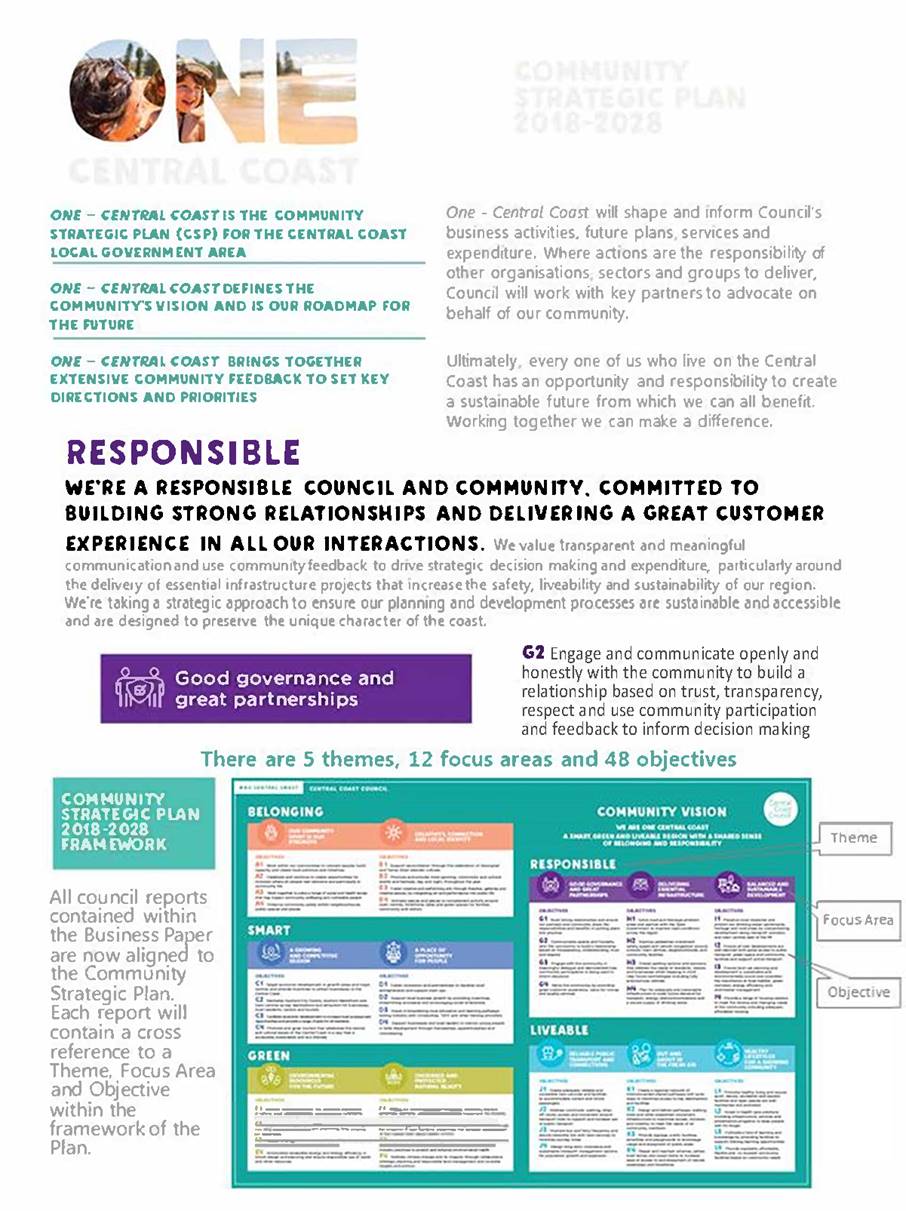
Link to Community Strategic Plan
Theme 3: Green
|
Goal E: Environmental resources for the future |
|
G-E3: Reduce littering, minimise waste to landfill and educate to strengthen positive environmental behaviours. |
Risk Management
The overarching objective of the Phased approach taken by Council is to ensure the project risks are appropriately identified and managed. Additional oversight from the OLG as part of the PPP process ensures integrity of the project and risk management applied.
Project specific risks have also been identified, assessed, and documented through a comprehensive risk assessment conducted to serve as an input to the Feasibility Report and in refining the commercial aspects of the project. A summary of the high-level risk categories and risks are detailed below.
· Procurement and stakeholder management
· Site risk
· Design and construction risk
· Commercial risks
· Feedstock risks
· Operating risks
· Financial risks
· Regulatory/political risks
· Force majeure; and
· Default risk
A key risk that this Business Case and recommended solution seeks to address relates to Councils legislative requirement to provide a FOGO collection service by July 2030 to comply with the NSW Protection of the Environment Legislation Amendment (FOGO Recycling) Act 2025. Failure to do so would be a breach of the legislation and carries significant penalties. Council would be at risk of receiving annual fines potentially exceeding $19m.
Further detailed assessment and information on risks is contained in Section 8 – Risk Analysis (pg. 52) of the attached FOGO Business Case.
The Business Case demonstrates that the recommended solution provides a suitable Value for Money solution which remains financially viable. The supported recommendation allows Council to proceed to EOI stages to seek industry feedback and further cost estimates to inform the next stages.
Critical Dates or Timeframes
NSW Councils are required to provide households who receive a residual (red lid) waste collection service with a food organics and garden organics (FOGO) waste service by 1 July 2030.
Councils Operational Plan Action incorporates the following relevant Service Activity and Target date.
|
ID. |
Service Activity |
Target |
|
DP_071 |
Investigate and plan for a large-scale processing solution for Food Organics and Garden Organics (FOGO) |
Detailed business case completed by 30 June 2025 |
|
CPA3628 FOGO Facility Business Case (Final Draft) - Redacted |
Provided Under Separate Cover |
D16824170 |
|
|
CPA3628 07.05.25_FOGO Facility Business Case (Final Draft *Confidential) - |
Provided Under Separate Cover |
D16824225 |
|
Item No: 1.5 |
|
|
Title: Draft Flood Risk Management Policy - for Public Exhibition |
|
|
Department: Environment and Planning |
|
|
10 June 2025 Extraordinary Environment and Planning Committee |
|
Reference: F2004/00144 - D16489730
Author: Peter Sheath, Unit Manager Environmental Management
Manager: Luke Sulkowski, Unit Manager Environmental Management
Executive: Shannon Turkington, Acting Director Environment and Planning
That the Committee
1 Recommends to Council that Council endorses the public exhibition of the draft Flood Risk Management Policy for a period of not less than 28 days.
2 Notes that a further report will be provided following the public exhibition period.
|
Report purpose
To seek a resolution to publicly exhibit the draft Flood Risk Management Policy for not less than 28 days.
Executive Summary
The draft Policy clarifies Council’s flood risk management responsibilities and identifies an emissions scenario for considering the impacts of climate change.
The emissions scenario will allow metrics to be determined for projected sea level rise which can be applied for planning purposes into the future. The policy also establishes appropriate planning horizons for different types of development and infrastructure assets.
|
Background
Council’s flood risk management responsibilities are defined by NSW legislation and Gazetted guidelines. There is no existing flood policy for the Central Coast with the flood risk management impacts of sea level rise assessed differently between the former Gosford and Wyong Local Government Areas.
Statutory consideration of climate change is required as part of Council’s flood risk management responsibilities, as outlined in the following legislation:
· NSW Flood Prone Land Policy
· NSW Flood Risk Management Manual
· Local Government Act 1993
· NSW Planning Circular PS 24-001 – Update on addressing flood risk in planning decisions
· Central Coast Local Environment Plan 2022.
Current Status
A draft Flood Risk Management Policy has been developed to clarify Council’s approach to flood risk management in accordance with statutory responsibilities as defined by the NSW Government and to adopt a greenhouse gas emissions scenario for the sake of considering the impacts of climate change.
Report
The draft Flood Risk Management Policy has been prepared to provide a consistent approach for the management of flood risk across the Central Coast. The draft policy applies to:
· Activities or development carried out on flood prone land, including land use planning, development control, infrastructure planning, and capital works.
· Advice about flood prone land provided by any Council staff member to any internal or external customer.
The objectives of this Policy are:
· To clarify Council’s Flood Risk Management statutory responsibilities as defined by the NSW Government.
a) The relevant legislation is listed at part 3.1 of the draft policy.
· To adopt a greenhouse gas emissions scenario for the sake of considering the impacts of climate change.
a) The draft policy includes the recommended emissions scenario (Medium SSP2-4.5), as shown by the yellow line in the figure below. This is the most likely emissions trajectory based on the most recent Intergovernmental Panel on Climate Change advice.
b) Note that Council may alternatively consider adopting the High SSP3-7.0 emissions scenario (red line), or the Very High SSP5-8.5 emissions scenario, which is a more precautionary approach.
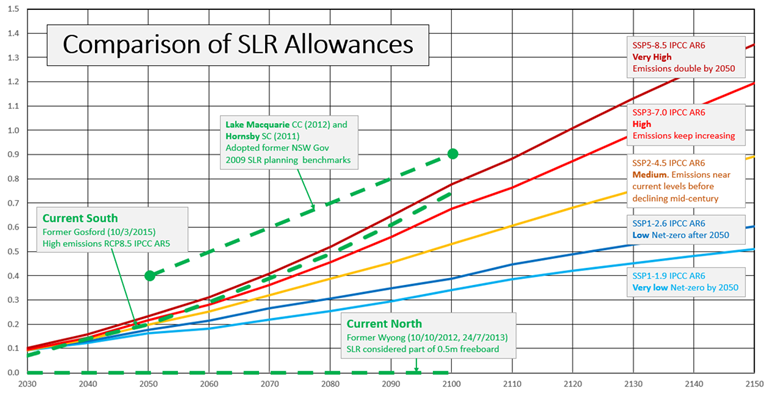
Figure 1: Comparison of Sea Level Rise (SLR) allowances under different emissions scenarios and compared to current south (former Gosford LGA) current north (former Wyong LGA) and Lake Macquarie and Hornsby Council’s.
Stakeholder Engagement
The draft Policy was considered in presentations to Council on both 18 February 2025 and 18 March 2025.
After each of the above stages of consultation the draft Policy was amended to address the comments and to develop a draft policy intended for public exhibition.
Consultation with external stakeholders will be undertaken as part of the public exhibition.
Financial Considerations
Financial Year (FY) Implications
The proposal does not have financial implications for the current year or outer years in the LTFP.
Budget and Long-Term Financial Plan (LTFP) Impact
The FY adopted budget includes funding for this proposal.
There is no financial impact arising from the recommendations of this report. The policy will however help guide well considered future investment in more financially sustainable and resilient infrastructure and development across the Central Coast.
Link to Community Strategic Plan
Theme 3: Green
|
Goal F: Cherished and protected natural beauty |
|
G-F4: Address climate change and its impacts through collaborative strategic planning and responsible land management and consider targets and actions. |
Risk Management
The
policy promotes the appropriate consideration of risk to life and property, as
part of development and infrastructure decisions, as well as consideration of
safe and efficient evacuation routes on the road network.
Critical Dates or Timeframes
Nil.
|
DRAFT Flood Policy |
Provided Under Separate Cover |
D16300632 |
|
Item No: 1.6 |
|
|
Title: Planning Proposal Statistics |
|
|
Department: Environment and Planning |
|
|
10 June 2025 Extraordinary Environment and Planning Committee |
|
Reference: F2004/00550 - D16841452
Author: Marie Llamas, Research and Project Officer Local Planning and Policy
Manager: Scott Duncan, Section Manager Local Planning and Policy , Section Manager Local Planning and Policy
Executive: Shannon Turkington, Acting Director Environment and Planning
That the Committee notes the Planning Proposal information contained within this report.
|
Report purpose
To present to the Environment and Planning Committee current Planning Proposals under assessment by Council.
Executive Summary
Planning Proposal information is provided below for the information of the Committee.
|
Report
The information contained in this report provides a summary of the current Planning Proposals under assessment by Council staff as at time this report was finalised.
|
Planning Proposal No. |
Location & Description |
Primary Purpose |
Status |
Comment |
|
RZ/111/2020 |
945 Old Pacific Hwy & 66 Myoora Rd, SOMERSBY (Old Sydney Town) |
Rezoning from C4 Environmental Living to multi zone |
Pre-Gateway |
Investigative studies being undertaken by applicant |
|
RZ/2/2023 |
239 Debenham Rd North, SOMERSBY |
Rezone from RU2 Rural Landscape to C4 Environmental Living |
Pre-Gateway |
Investigative studies being undertaken by applicant |
|
RZ/2/2020 |
Jilliby - Stage 2 |
Rezoning from RU2 Rural Landscape to C4 Environmental Living and C2 Environmental Conservation |
Pre-Gateway |
Investigative studies being undertaken by applicant |
|
RZ/4/2024 |
32 Caroline St, EAST GOSFORD and 2A Melbourne St, EAST GOSFORD |
To rezone the land from R2 Low Density Residential to R1 General Residential, and to adopt the development standards applying to adjoining R1 zoned land |
Pre-Gateway |
A report was considered by the Environment and Planning Committee on 6 May 2025, seeking a recommendation to forward the Planning Proposal to the Minister for Planning and Public Spaces requesting a Gateway Determination. The minutes of the E&P Committee will be reported to the 27 May 2025 Ordinary Council Meeting seeking to adopt the recommendations of the Committee. |
|
RZ/6/2023 |
682a Coleridge Rd, BATEAU BAY |
Rezoning site to R1 General Residential from SP2 Road and Traffic Facility (Red Bus Depot), apply minimum lot size of 450m2, Building Height of 9.5m, FSR 0:6:1 and amend Schedule 1 of CCLEP |
Gateway Issued |
Gateway Determination was issued by the Department of Planning, Housing and Infrastructure. Staff are working through the requirements of the Gateway. |
|
RZ/1/2024 |
126 Somersby Falls, SOMERSBY |
Proposal to rezone site from RU1 Primary Production to E4 General Industrial |
Post Exhibition |
A report was considered by the Environment and Planning Committee on 6 May 2025, seeking to proceed with the steps for drafting and making of the amendments to the Central Coast Local Environmental Plan 2022. The minutes of the E&P Committee will be reported to the 27 May 2025 Ordinary Council Meeting seeking to adopt the recommendations of the Committee. |
|
RZ/1/2023 |
243 Green Park Parade, WOONGARRAH (WTC Stage 10) |
Proposal to rezone part of the site from MU1 Mixed Use to E1 Local Centre and R1 General Residential. |
Post Exhibition |
The Planning Proposal was publicly exhibited from 8 April to 6 May 2025. Staff are currently reviewing the submissions received. |
|
RZ/3/2023 |
Reclassification of Council owned land – Community to Operational |
Reclassification from Community to Operational Land (no rezoning) |
Plan Making and Finalisation |
Planning Proposal is with Department of Planning, Housing and Infrastructure for Plan Making and Finalisation. |
Table 1: Planning Proposals under assessment
Stakeholder Engagement
Nil.
Financial Considerations
Financial Year (FY) Implications.
The proposal does not have financial implications for the current year or outer years in the LTFP.
Budget and Long-Term Financial Plan (LTFP) Impact.
The FY adopted budget includes funding for this proposal and the LTFP includes funding for the ongoing impact.
Link to Community Strategic Plan
Theme 3: Green
|
Goal I: Balanced and sustainable development |
|
R-I2: Ensure all new developments are well planned with good access to public transport, green space and community facilities and support active transport. |
Risk Management
Nil.
Critical Dates or Timeframes
Nil.